
Introduction
Ten years is more than an anniversary. It represents thousands of conversations, business challenges, implementations, lessons, partnerships, and opportunities to help organizations work better.
Founded in 2016, Octfis Techno LLP began with a clear goal: help businesses simplify technology and build practical systems around their real operational needs. Today, Octfis operates as a Zoho Premium Partner, providing Zoho implementation, customization, integration, workflow automation, and industry-specific solutions to businesses in India and internationally. Octfis
As Octfis completes its 10-year journey from 2016 to 2026, the milestone is not simply about how long the company has existed. It is about how far the organization, its people, its customers, and its capabilities have progressed together.
Where the Octfis Journey Began: 2016
Octfis Techno LLP was established in 2016, initially focusing on solving a common problem faced by small and growing businesses: technology was available, but companies often struggled to adapt it to their actual workflows.
Instead of treating software implementation as a simple configuration exercise, Octfis focused on understanding the processes behind the software.
That meant asking questions such as:
- How does a business actually manage leads?
- Where does information get duplicated?
- Which approvals slow operations down?
- Which repetitive tasks can be automated?
- How should sales, finance, inventory, HR, and customer service work together?
- Where are managers losing visibility?
This process-driven approach gradually became a defining part of Octfis' implementation philosophy.
An earlier Octfis account of its journey describes the company as having started in 2016 with the objective of bridging the gap between growing businesses and customized technology solutions.

2017: Becoming an Authorised Zoho Partner
A major milestone arrived in October 2017, when Octfis became an Authorised Zoho Partner.
At that stage, according to Octfis' previously published company history, the business had approximately 14 team members and one office. Octfis
The partnership with Zoho created an opportunity to solve a much broader range of operational challenges.
Instead of businesses using isolated tools for sales, finance, inventory, customer service, collaboration, or HR, Zoho's ecosystem made it possible to create increasingly connected business processes.
For Octfis, this became an opportunity to combine software with practical implementation expertise.
2017–2019: Learning What Businesses Really Need
The early years were important because they helped shape the company's implementation methodology.
Different businesses could purchase the same application while needing completely different systems.
A manufacturing company, for example, may need:
- Lead and quotation management
- Vendor management
- Raw-material tracking
- Inventory controls
- Approval workflows
- Accounting integration
- Production or job-work processes
A service company may instead prioritize:
- Lead assignment
- Sales automation
- Projects
- Timesheets
- Customer support
- Billing
- Analytics
This experience reinforced an important lesson:
Successful digital transformation is rarely about installing more software. It is about connecting technology with the way people actually work.
Octfis increasingly focused on customization, integrations, automation, and business-specific processes rather than relying only on standard software configuration.
2020: From Implementation to Business Automation
2020: From Implementation to Business Automation
By 2020, Octfis had progressed to Zoho Advanced Partner status.
The company's published history states that this period included approximately 42 team members across two office locations, along with growing expertise in Zoho CRM, Zoho One, finance applications, and HR solutions. Octfis
This period also reflected a broader shift in customer expectations.
Businesses increasingly wanted more than individual applications.
They wanted connected processes such as:
Website Lead → CRM → Sales Follow-Up → Quotation → Order → Inventory → Invoice → Payment → Analytics
This required deeper expertise in:
- Workflow automation
- APIs
- Custom functions
- Third-party integrations
- Data migration
- Application customization
- Reporting
- User permissions
- Cross-department workflows
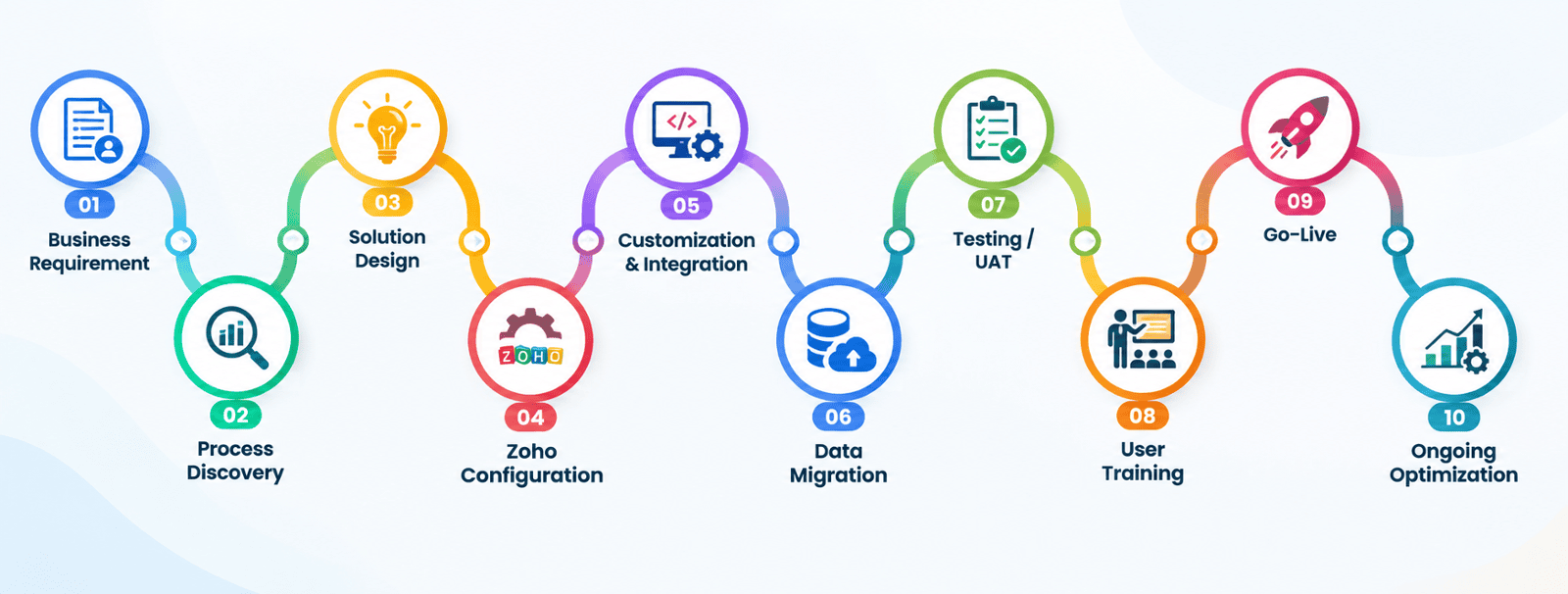
This diagram can help readers understand that professional Zoho implementation goes beyond simply creating an account and switching on features.
2022: Becoming a Zoho Premium Partner
Another significant milestone came in 2022, when Octfis achieved Zoho Premium Partner status.
Octfis' published company history connects this progression with expanding implementation experience, a larger team, multiple locations, and increasingly complex customer projects. Octfis
For customers, deeper implementation experience becomes particularly important when multiple applications need to operate as one system.
| Business Requirement | Possible Zoho Solution |
|---|---|
| Lead and sales management | Zoho CRM |
| Accounting | Zoho Books |
| Stock management | Zoho Inventory |
| Customer support | Zoho Desk |
| HR management | Zoho People |
| Recruitment | Zoho Recruit |
| Custom applications | Zoho Creator |
| Analytics | Zoho Analytics |
| Workflow integration | Zoho Flow |
| Complete business suite | Zoho One |
The real challenge is not selecting these applications individually.
The challenge is making them work together around the company's processes.
Moving Beyond Standard Zoho Implementation
Over the years, Octfis expanded its work into several areas of business transformation.
Zoho Implementation
Businesses need applications configured around their actual organizational structure, teams, sales stages, tax requirements, approvals, reporting needs, and operating model.
Zoho Customization
Standard functionality does not cover every industry-specific requirement.
Customization may include:
- Custom modules
- Custom fields
- Approval processes
- Blueprint workflows
- Custom functions
- Automated notifications
- Business rules
- Custom dashboards
Zoho Integration
A modern business rarely operates entirely inside one software ecosystem.
Typical integration requirements include:
- Websites
- Payment gateways
- E-commerce platforms
- Telephony
- Accounting platforms
- ERP systems
- External APIs
- Industry-specific applications
Data Migration
Moving from spreadsheets, legacy applications, or other ERP/CRM systems requires careful planning.
Successful migration involves:
- Data assessment
- Data cleaning
- Field mapping
- Import preparation
- Validation
- Reconciliation
- User verification
Workflow Automation
Automation allows companies to reduce repetitive work while maintaining process consistency.
Examples include:
- Automatically assigning leads
- Sending follow-up reminders
- Triggering approvals
- Creating invoices
- Updating inventory
- Escalating support tickets
- Generating reports
- Synchronizing information between applications
From Local Expertise to Global Reach
Another important chapter in the Octfis journey has been geographic expansion.
The company's current website lists offices or branches in Surat, Ahmedabad, Rajkot, and Canada, alongside its head office operations in Gujarat. Octfis
Octfis has also previously documented its expansion into Canada as part of its international growth. Octfis
This expansion reflects an important change in the nature of business software consulting.
Cloud applications allow implementation teams to support businesses across regions while adapting systems to different workflows, organizational structures, and business environments.
Octfis at 10 Years: The Numbers Behind the Journey
Octfis' current company website highlights several organizational milestones:
| Milestone | Current Figure |
|---|---|
| Businesses / Clients Served | 8,500+ |
| Professionals / Experts | 100+ |
| Zoho Applications Expertise | 60+ |
| Global Branches | 5 |
| Journey | 2016–2026 |
These figures are presented on Octfis' current corporate website and company materials. Octfis
But numbers only describe part of the story.
Behind every implementation is a business problem that had to be understood before it could be solved.
What 8,500+ Business Experiences Can Teach You
Working across thousands of business scenarios creates recurring patterns.
One of the strongest is that software problems are often actually process problems.
Consider a company that says:
"Our CRM is not working."
The actual problem might be:
- Salespeople do not update opportunities.
- Lead ownership is unclear.
- Follow-ups are manual.
- Duplicate customer information exists.
- Reports do not reflect reality.
- Sales and finance data are disconnected.
Simply changing the CRM rarely solves those problems.
The solution requires process analysis first.
That is why a structured implementation approach should normally include:
Discovery → Process Analysis → Solution Design → Configuration → Integration → Migration → UAT → Training → Go-Live → Optimization
Industries Have Different Problems—Software Must Reflect That
One of the lessons from a decade of implementation work is that "one-size-fits-all" software rarely fits perfectly.
Consider three businesses.
Manufacturing Business
Needs visibility across:
- Purchase
- Inventory
- Vendors
- Production
- Job work
- Finished goods
- Dispatch
- Accounting
Professional Services Company
Needs:
- Lead management
- Proposals
- Projects
- Timesheets
- Billing
- Client communication
E-commerce Business
Needs:
- Orders
- Customer information
- Inventory
- Shipping
- Payment reconciliation
- Marketing
- Support
All three companies may use Zoho.
But their implementation architectures should be very different.
This is why understanding the business comes before configuring the application.
Custom Solutions Became an Important Part of the Journey
Some business requirements cannot be solved entirely with standard applications.
This is where platforms such as Zoho Creator become valuable.
Custom applications can help businesses manage highly specialized workflows such as:
- Manufacturing processes
- Textile job work
- Vendor management
- Industry-specific inventory
- Approval systems
- Field operations
- Internal request management
- Custom order processing
The objective should not be customization for its own sake.
The objective is to build only what the business genuinely needs while keeping the overall system manageable.
What Businesses Expect From Technology Has Changed in 10 Years
Business software requirements in 2026 look very different from those of 2016.
Previously, organizations frequently focused on digitizing individual activities.
Today, businesses increasingly expect connected operations.
Then
The goal has shifted from digitization to integration and automation.
Businesses increasingly want one connected source of operational information.
Business Benefits of a Connected Zoho Ecosystem
A properly implemented Zoho environment can help businesses improve several operational areas.
Better Visibility
Management teams can access more structured information about sales, finance, inventory, customers, and operations.
Reduced Manual Work
Automation can eliminate repetitive activities and reduce dependence on spreadsheets.
Improved Data Consistency
Integrated systems can reduce duplicate records and repeated manual entry.
Stronger Process Control
Approvals, rules, roles, and workflows help businesses standardize operations.
Better Decision-Making
Structured data and analytics provide management with more usable insights.
Scalability
A properly designed system can evolve as employees, customers, locations, transactions, and business processes grow.
Five Lessons From the Octfis 10-Year Journey
1. Understand the Process Before Choosing the Technology
Software should support the business process—not force teams into unnecessary complexity.
2. Automation Should Solve Real Problems
Automating a poorly designed process only makes the problem happen faster.
Fix the process first.
Then automate it.
3. User Adoption Matters as Much as Configuration
A technically excellent implementation still fails if employees do not understand or use it properly.
Training and change management therefore matter.
4. Integration Should Reduce Data Silos
Applications should exchange information where it improves operations.
Unnecessary integrations, however, create complexity.
5. Digital Transformation Never Really Ends
Businesses evolve.
Their software must evolve with them.
Continuous optimization is therefore more effective than treating implementation as a one-time project.
Common Mistakes Businesses Should Avoid During Zoho Implementation
Even powerful software can underperform when the implementation strategy is weak.
Mistake 1: Configuring Before Mapping Processes
First understand:
- Current workflow
- Bottlenecks
- Roles
- Approval points
- Reporting requirements
Then configure the application.
Mistake 2: Migrating Bad Data
Do not move duplicate, incomplete, or obsolete data simply because it exists.
Clean it first.
Mistake 3: Automating Everything
Automation should remove unnecessary work.
It should not create complicated workflows employees cannot understand.
Mistake 4: Ignoring User Training
Employees need to understand not only how to use the system but also why the new workflow exists.
Mistake 5: Trying to Build Everything on Day One
Prioritize critical workflows first.
Then expand gradually.
A Practical Zoho Implementation Strategy
Businesses planning a new Zoho implementation can follow this approach.
Phase 1: Discovery
Document business goals, challenges, teams, applications, and expected outcomes.
Phase 2: Process Mapping
Create current-state and future-state workflows.
Phase 3: Solution Architecture
Determine:
- Applications
- Integrations
- Customization
- Permissions
- Reports
- Migration requirements
Phase 4: Configuration and Development
Build the agreed system.
Phase 5: Migration and Testing
Test both functionality and data integrity.
Phase 6: User Acceptance Testing
Real users should test real-world business scenarios.
Phase 7: Training
Provide role-specific training.
Phase 8: Go-Live
Launch using a controlled transition plan.
Phase 9: Optimization
Measure adoption, identify bottlenecks, and improve the system.
From 2016 to 2026: What Has Stayed Constant?
Technology has changed enormously.
Applications have evolved.
Automation has become more sophisticated.
AI is increasingly part of business software.
Customer expectations have changed.
Yet one principle remains constant:
Technology creates value only when it solves a real business problem.
That principle continues to shape how Octfis approaches implementation, customization, integrations, and business automation.
Octfis currently describes its mission as making technology simple, accessible, and scalable through the Zoho ecosystem. Octfis
The People Behind the 10-Year Journey
A decade-long business journey cannot be created by technology alone.
It is built by people.
It includes:
- Customers who trusted the organization
- Employees who solved complex problems
- Partners who supported growth
- Teams who handled implementations
- Consultants who mapped processes
- Developers who built custom solutions
- Support teams who resolved issues
- Customers who provided feedback
- Leaders who continued investing in capabilities
That is why the message behind this milestone is simple:
Powered by People. Driven by Possibilities.
Looking Beyond 2026
Completing 10 years is an opportunity to recognize the past, but it is also a starting point for the next phase.
The business software landscape is moving toward:
- AI-assisted workflows
- Intelligent automation
- Unified business data
- Predictive analytics
- Low-code development
- Connected customer experiences
- Industry-specific applications
- Deeper system integration
For Octfis, the opportunity ahead is to continue helping businesses turn those technologies into practical operational improvements.
Not technology for technology's sake.
Technology designed around the business.
Frequently Asked Questions
Ten Years Completed. The Next Chapter Begins.
From a business established in 2016 to a Zoho Premium Partner serving thousands of organizations, Octfis Techno LLP's first decade reflects continuous learning, expanding expertise, and a focus on solving practical business problems.
2016 was the beginning.
2026 marks 10 years.
The journey continues.
To every customer, employee, partner, and supporter who has been part of these ten years:
Thank you for being part of the Octfis journey.
Ready to Build the Next Stage of Your Business?
Whether you are starting with Zoho, replacing disconnected systems, automating workflows, integrating applications, or optimizing an existing Zoho environment, the next step begins with understanding your processes.