
Introduction
Managing imports is one of the most documentation-heavy and compliance-driven processes in any business. From coordinating with customs and logistics partners to calculating duties, taxes, and ensuring regulatory accuracy, the Bill of Entry becomes the backbone of the entire import lifecycle. When handled manually, even small inconsistencies can result in delays, penalties, or financial misreporting.
Zoho addresses these challenges by digitizing and centralizing import operations. With its Bill of Entry module and automated workflows, businesses gain clarity, control, and compliance—without operational complexity. This blog explains how Zoho streamlines import management from shipment arrival to final clearance.
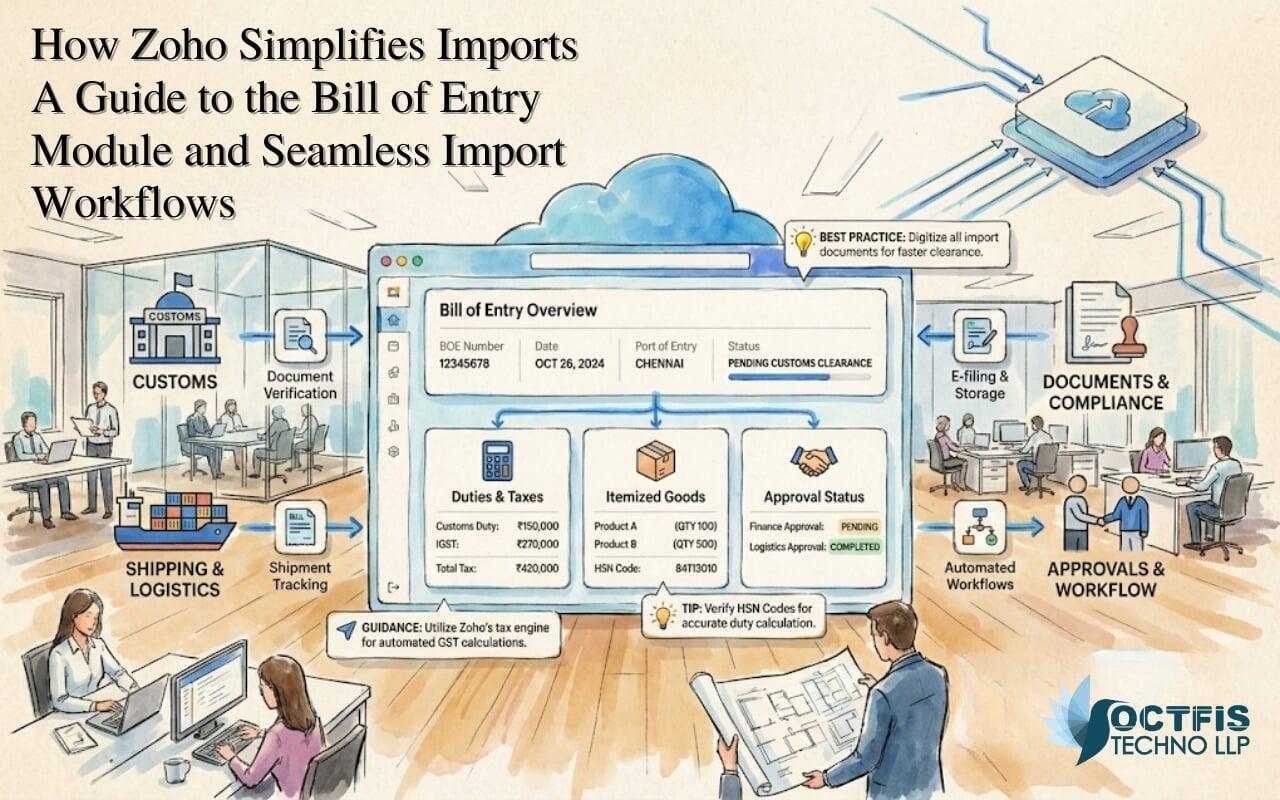
What Is a Bill of Entry and Why It Matters
A Bill of Entry is a legal document filed with customs authorities when goods are imported into a country. It captures essential details such as:
Importer and shipment information
Port of entry and BOE number
Itemized goods with HSN codes
Applicable customs duty, IGST, and other taxes
Clearance and approval status
Accurate and timely filing of the Bill of Entry is critical. Any error in valuation, classification, or tax calculation can lead to compliance risks and clearance delays.
Challenges in Traditional Import Management
Many organizations still rely on fragmented systems and manual processes to manage imports. Common challenges include:
Disconnected data between finance, logistics, and compliance teams
Manual calculation of customs duties and GST
Difficulty tracking approval and clearance status
Poor visibility into shipment and document history
Increased risk of errors and audit issues
These gaps not only slow down operations but also impact working capital and vendor relationships.
How Zoho’s Bill of Entry Module Simplifies Imports
Zoho brings structure and automation to import workflows by offering a centralized Bill of Entry management system.
Key capabilities include:
Centralized Bill of Entry Overview
All BOE details—number, date, port of entry, shipment status, and documentation—are available in one unified dashboard. This ensures real-time visibility for finance and logistics teams.
Automated Duties and Tax Calculation
Zoho’s built-in tax engine calculates customs duty, IGST, and other applicable taxes automatically, reducing dependency on manual spreadsheets and minimizing calculation errors.
Itemized Goods and HSN Code Validation
Each imported product can be recorded with quantity, value, and HSN code. Built-in validation helps ensure accurate classification for correct duty assessment.
Approval and Clearance Tracking
Track finance and logistics approvals with clear status indicators. Automated workflows ensure no step is missed, from document verification to customs clearance.
Seamless Integration with Shipping and Documentation
Zoho connects import data with shipping and logistics workflows, enabling:
Shipment tracking linked directly to the Bill of Entry
Digital storage of import documents for easy retrieval
E-filing readiness for faster customs processing
Improved coordination between customs agents and internal teams
This integration eliminates silos and keeps all stakeholders aligned.
Best Practices Enabled by Zoho
Zoho encourages compliance-driven efficiency through:
Digitized documentation for faster audits and clear traceability
Automated reminders for pending approvals or missing data
Consistent data flow between accounting, inventory, and logistics
Reduced turnaround time for customs clearance
Business Impact of Automating Import Workflows
Organizations using Zoho for import management benefit from:
Faster clearance cycles and reduced demurrage costs
Improved compliance with customs and GST regulations
Better financial accuracy and reporting
Enhanced operational transparency across teams
Automation transforms imports from a reactive process into a predictable, well-governed workflow.
Why Octfis Recommends Zoho for Import Management
At Octfis Techno LLP, we help businesses design and implement Zoho solutions that align with real-world import operations. Our expertise ensures:
Proper configuration of the Bill of Entry module
Custom workflows tailored to your compliance needs
Seamless integration with accounting and inventory systems
Ongoing optimization as regulations evolve
Conclusion
Import management does not have to be complex or error-prone. With Zoho’s Bill of Entry module and automated import workflows, businesses can gain control, accuracy, and confidence across every stage of the import process.
If your organization is ready to simplify imports, improve compliance, and reduce operational friction, Zoho—implemented the right way—can make that transformation seamless.